Copper Peptides
GHK-Cu Research Peptide
GHK-Cu is a naturally occurring copper complex of the tripeptide glycyl-L-histidyl-L-lysine. It is a widely referenced compound in published in-vitro research on copper-peptide signaling and extracellular matrix pathways.
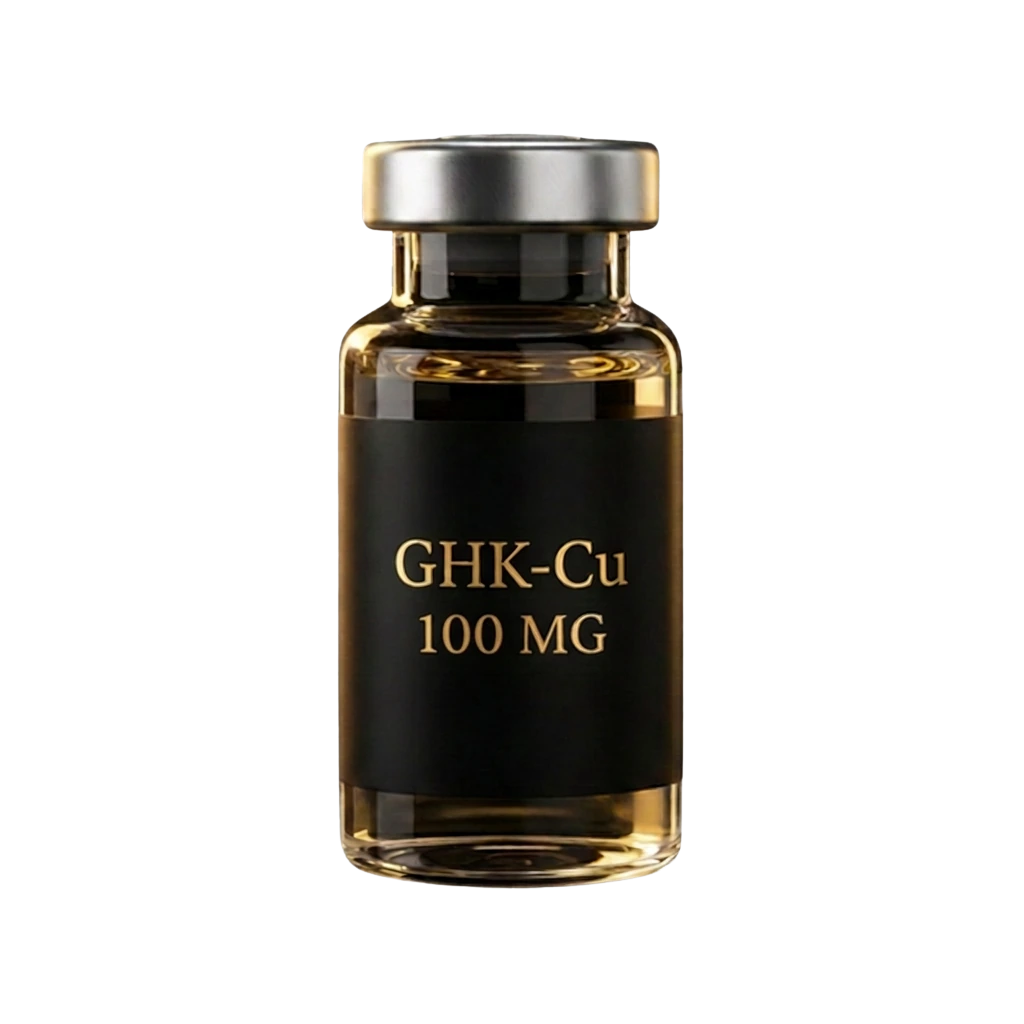
$39.99 — 50mg vial
| Purity | ≥99% |
| Quantity | 50mg |
| Molecular Weight | 403.93 g/mol |
| Sequence | Gly-His-Lys·Cu²⁺ |
| Category | Copper Peptides |
| Latest batch tested | 05/30/26 |
GHK-Cu in Research
GHK-Cu is the copper(II) complex of the naturally occurring tripeptide glycyl-L-histidyl-L-lysine, first identified in human plasma. At 403.93 g/mol it is one of the smallest compounds in our catalog, with a large research literature covering collagen and elastin synthesis, matrix metalloproteinase modulation, and tissue-remodeling gene expression in cell and animal models.
This listing supplies a 50mg research vial at ≥99% purity — the characteristic blue color of the vial contents comes from the coordinated copper ion itself. Each lot ships with independent HPLC and MS verification on a batch-specific certificate of analysis.
Research Overview
- Investigated for stimulation of collagen and elastin synthesis
- Studied for wound contraction and skin remodeling properties
- Research into antioxidant and anti-inflammatory effects
- Explored for promotion of blood vessel and nerve outgrowth
- Demonstrated gene expression modulation in vitro studies
Quality & Testing
Every GHK-Cu batch is verified by independent third-party HPLC and mass-spectrometry testing, with a batch-specific certificate of analysis available on the COA page.
Laboratory Handling & Storage
Lyophilized peptides are supplied as a freeze-dried powder and are most stable stored cold (2–8°C), protected from light and moisture, in the original sealed vial. Under these conditions the research literature generally reports multi-year integrity for dry peptide material.
Once reconstituted in a laboratory setting, solutions are typically stored refrigerated and used within the window appropriate to the diluent and compound; repeated freeze–thaw cycles are avoided because they can promote aggregation. See our research overview on reconstitution and lyophilization for the underlying formulation science.
The copper complex gives reconstituted GHK-Cu solutions a distinctive blue color; color intensity varies with concentration and is expected.
Frequently Asked Questions
What is GHK-Cu?
GHK-Cu is a copper complex of the tripeptide Gly-His-Lys, a sequence found naturally in human plasma. It is studied in laboratory models of tissue remodeling, collagen synthesis, and gene-expression modulation.
Why is GHK-Cu blue?
The coordinated copper(II) ion absorbs in the red part of the spectrum, giving both the lyophilized complex and its solutions a characteristic blue color. This is a property of the chemistry, not an additive.
What research areas cite GHK-Cu most?
The literature concentrates on dermal-matrix biology — collagen/elastin synthesis and wound contraction in models — plus broader work on matrix metalloproteinases and remodeling-related gene expression.
Is GHK-Cu for human use?
No. This GHK-Cu is a laboratory reference compound for in-vitro and preclinical research only. Not for human consumption or cosmetic formulation.